
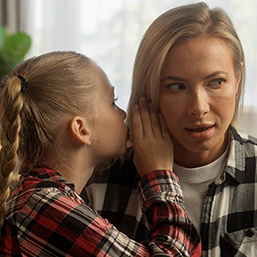
“Noah said a bad word!”
“Emma is staring at me funny!”
It feels like the tattling never stops!
The dictionary defines tattling as reporting another's wrongdoing, but it often feels like it's a child’s way of getting attention while throwing another kid directly under a bus.
So, why do we pay attention? Because sometimes kids see things we don’t, and we need to keep everyone safe.
What's a Parent to Do?
Dr Barbara Coloroso's perspective on tattling is one that has helped me during my time as a teacher, parent, and parenting educator. Her famous quote makes it very clear.
Telling gets kids out of trouble.
Tattling gets kids into trouble.
It's that simple. We want our kids to tell us if their friend or sibling is in trouble by way of:
However, if it’s just about making themselves appear to be the more loveable sibling, or roasting another child, we want it to stop. These examples demonstrate one approach parents can take.
Example 1:
Kid: “Johnny is playing too long on the swings, he's not sharing!”
Parent: “Are you getting Johnny out of trouble or into trouble?”
Kid: “But it's not fair!”
Parent: “Out of trouble or into trouble?”
Kid: “Into trouble.”
Parent: “That’s tattling, don’t tell me.”
Example 2:
Kid: “Sara is throwing rocks at the ducks!”
Parent: “Sounds like the ducks are in trouble. Thanks for telling me, let's go get them out of trouble!”
Parent as Teacher
Little kids are learning the rules. They are trying to figure out what’s right and what’s wrong, and they may end up coming to us out of frustration or confusion about what is supposed to be happening, without any sense of how to make it right.
This means that even as we’re doing our best to teach them the difference between tattling and telling, we can go one step further and help them to begin to solve their own problems rather than constantly relying on us.
When it comes to tattling, invite the child to articulate what they need rather than complaining about someone else’s role in the problem. Encourage the child to say this to the other child. You’ll likely need to be present to help both parties figure out a way of making it work, at least at first.
Let’s revisit the first example:
Kid: “Johnny is playing too long on the swings, he’s not sharing!“
Parent: “How is this affecting you?“
Kid: “I want a turn on the swings, and he is being mean.“
Parent: “Okay so you would like a turn on the swings. How can you make that happen?“
Kid: “I’ve asked, and he won’t stop.“
Parent: “I’ll come with you again just to stand by and see how you two can work out the problem. What will you say to Johnny this time?“
Kid: “I WANT A TURN!“
Parent: “Can you use the sentence, “Can I have a turn when you’re done, please?” Let’s try that.“
Parent and Kid approach the swing.
Kid: “Johnny, can I have a turn when you’re done on the swing, please?“
Johnny: “Yep, but I’m not done yet.“
Kid: “I can wait.“
Parent: “Johnny, I think you’ll be done in ten more swings or 15 more swings. Which do you choose?“
Johnny: “I’ll do 15 more swings.“
Parent: “Sounds good.“
In this example, the parent helps the kids to learn to take turns, and how to ask for what they need. Of course, this is likely going to be happening multiple times a day when kids are little. There’s always an opportunity to guide them more than tell them. “This is just like the problem we had earlier this afternoon. What words did you learn then that you can use now?”
From Tots to Teens
What we teach our littles transitions to their lives as teens. We want our kids to come to us, an adult in charge, when they know that a friend is about to harm themselves, harm someone else, or something. Will telling get their friend into trouble? It might in the short term, but the trouble it prevents will keep everyone safer in the long term.
Author, blogger, podcast host, and parenting expert, Julie Freedman Smith has been supporting parents across North America for 20 years. Through her company JFS Parent Education, she helps parents find relief from their everyday parenting challenges. Want to know how she can help you? Email her today:
See our related articles:




Calgary’s Child Magazine © 2026 Calgary’s Child