
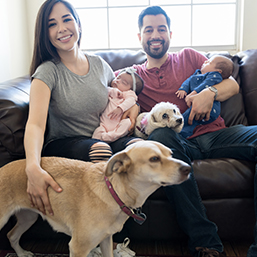
We place so many expectations on our dogs. When we imagine our families expanding, we often picture our dogs stepping effortlessly into roles like sibling, protector, and best friend. We assume the bond will be instant and strong the moment we bring our baby home. That’s the story we see on social media and in movies – a romanticized vision of dogs intuitively knowing what to do, without guidance or support.
That’s why it can feel so jarring when things don’t go as smoothly as planned. No one prepares you for your dog growling at your baby, or becoming overly fixated on them. No one prepares you for the moment you realize your dog isn’t comfortable with the baby – and that you suddenly see your dog not as your first child, but as an animal with teeth.
What the media doesn’t show is the very real shift that happens when a baby comes home. A dog who has had no time to adjust is suddenly expected to understand why they’re no longer allowed on the couch, or on mom’s lap while she feeds this strange, noisy little human their people are fiercely protective of.
Behaviors that were once normal or even encouraged are now treated as problems. Roughhousing with dad on the floor turns into dad getting upset because the dog is too excited and might step on the baby. Dropping a wet, soggy ball on mom’s lap used to be a game – now it’s about germs and safety. Walks change or disappear, meals are late or missed, barking feels more stressful, and while the people are always home, the dog actually gets less rest – day and night – as parents wake repeatedly to care for the baby.
Even if your dog has spent time around children or babies before, that doesn’t mean they’ll adjust seamlessly to a baby living in their home full time. There’s so much more to it. Many dogs don’t yet understand that a baby is a person. Babies don’t move like people, act like people, or communicate in predictable ways. They’re constantly changing. Dogs rely on predictability. They learn our routines, our patterns, and they thrive on consistency. Babies are anything but consistent, and they change everything about a dog’s environment, routine, and people.
And just as some dogs begin to settle into the baby phase, everything changes again. Now the baby moves. The tiny human everyone dotes on suddenly has adult-sized eyes, a giant head, and the ability to crawl straight toward the dog. So just as the dog starts to adapt, the rules shift again. This pattern repeats with every new developmental milestone – and it happens fast. Even the most social, tolerant, easygoing dogs can struggle.
This is why it’s so important to normalize how hard this can be for dogs – and to stop expecting them to simply “figure it out.” Preparing for these changes in advance can be the difference between a dog who is able to cope and adjust, and a situation that becomes stressful, unsafe, or overwhelming for everyone involved. Preparation can look like giving your dog predictable routines with baby in mind, setting up a “kid-free space” where they can decompress and be safely separated, and gradually exposing them to as many changes in the environment as they can before the baby arrives. It is also important to consider the things that they do with their dog now that may not be as desirable with a baby in arms and train alternatives or find a way to manage them. It’s important to know that if your dog struggles with this transition, you are not alone.
Getting in contact with a Family Paws Parent Educator and accessing a professional who is well educated in the dynamics between dogs and babies is not only a great way to prepare in advance but also find support when you do struggle. It is normal for bringing home a baby to be hard. Bringing home a new baby to a dog adds even more challenges, especially when our dog struggles with the change. But struggling does not mean failure, it just means extra support and understanding is needed.
Elysia has been working with dogs and kids for over a decade. She is a CPDT-KA certified trainer and a Family Paws Parent Educator. She is a mom of two young children, and co-owner of Pawstive Families Education & Training.
See our related articles:



Calgary’s Child Magazine © 2026 Calgary’s Child