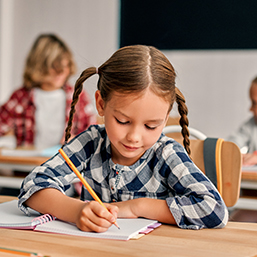
Self-directed learning begins at infancy. Babies naturally communicate needs and learn what works to get them met. This continues as toddlers and preschoolers spend their days at play – its own form of self-directed learning. Whether throwing rocks into puddles, catching worms, or pretend-cooking at a toy kitchen, children are experimenting with objects and learning at the same time. They become police officers, garbage truck drivers, nurses, doctors, and teachers, practicing imagination and connecting actions with natural consequences.
There are so many benefits for children who continue with this form of education.
Skills
In self-directed education, children choose an area of learning and are guided to ask questions and derive answers. Over time, children learn to organize themselves as they begin to develop procedures on their own.
Problem-solving happens by running small experiments, reading, listening to, and/or watching information about a desired topic and reflecting on this learning. Critical thinking helps learners determine biases present in these sources of information.
While self-directed education fosters the ability to work independently, there are often opportunities to confer with small groups or engage with experts to gain and share information. Kids may also enjoy teaching each other about discoveries made.
Self-directed learners merge several concepts while solving one problem. When devising an experiment to further their understanding, the child may need to:
Even with this small example, the child will need to use math, investigation, spelling, written or oral presentation, and sequencing to be sure to do each step in the correct order and be ready for the next step in the project.
The connection of concepts parallels the skills needed in real life to run a household, complete a team or family project, and work in the real world.
Values
Learning these skills also helps the student practice and understand key values which will carry them forward as they grow.
In self-directed learning, the child explores their curiosity as they determine what to explore, and how they will do so. From here, they must practice responsibility and self-discipline as they build a schedule, follow or stray from it, and adapt the plan to fit the new reality.
Perseverance is required and learned when things do not go as planned. Mistakes and unexpected developments provide opportunities for further learning, and this reality can be emotionally challenging. When things go wrong, learners may need to rely on those around them for support through feelings of frustration, anger, shame, and sadness. They learn that they are capable of handling disappointment. These challenges help build resilience and an awareness that they are strong enough to do hard things and find a way to move forward.
As a child works through each project, they gain an awareness of their abilities, along with a broader level of understanding. Courage may be required, especially when the learner needs to stretch their wings and try a new, daunting task. Overcoming this fear – be it approaching an unknown expert for help, or reaching beyond the comfortable – takes a certain strength and determination.
With each achievement, there is a reinforcement of the value of both process and product, as well as a level of confidence gained in completing the task.
Just as with the progress from infancy to toddler, preschooler and beyond, self-directed learning grows with the child. Because the learning is individualized, facilitators can meet the child where they are and set them up for success based on their age and stage. Starting and staying on track with a small task provides benefits for a child, who then carries that enthusiasm for learning into the next project.
Independently learned skills can also be generalized to help groups and small communities in which the child takes part, (family, playgroup, neighborhood). When kids begin to see themselves as problem-solvers, they are often motivated to cooperate when challenges arise between two or more individuals, like sharing a toy or working together to get a job done.
A child who thrives in this environment benefits in so many ways through skills gained, along with the values lived and internalized.
Author, blogger, podcast host, and parenting expert, Julie Freedman Smith has been supporting parents across North America for 20 years. Through her company JFS Parent Education, she helps parents find relief from their everyday parenting challenges. Want to know how she can help you? Email her:
See our related articles:



Calgary’s Child Magazine © 2026 Calgary’s Child