When caregivers think about their child’s school readiness, they often focus on academic skills like counting, recognizing letters, or writing their name. In reality, the skills that prepare a child for success in school and set the foundation for lifelong learning are much more fundamental. In my work as a child and family psychologist, I consistently see four key readiness skills that, when underdeveloped, can create challenges for children:
1. Functional communication skills. Functional communication isn’t about expanding your child’s academic vocabulary or teaching them to memorize and recite information. It’s about their ability to express needs, ask for help, and use language to solve everyday problems. Can your child ask for assistance when something feels too hard? Can they communicate what they want or need? When this skill is lagging, we often see an increase in challenging behaviors like outbursts, elopement (running away or avoiding a task), or shutdowns. For example, a child might avoid a writing activity and become upset when all they needed was a short break and didn’t yet have the language to say so. To build this skill, allow your preschooler small moments of frustration so they can practice communicating through them. For example, if your child gestures for a toy that’s out of reach or struggles to open something, pause for a few seconds before jumping in to help. This gives them a chance to try expressing themselves. Then model the language you want to see: “You can say, ‘Help me open it, please.’”
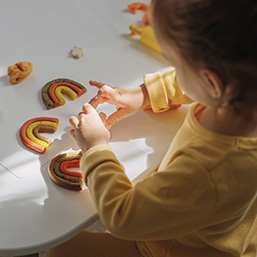
2. Basic fine motor skills. Fine motor skills involve the movement of small muscles, especially in the hands and fingers. This skill is crucial for tasks like writing, tracing, coloring, and cutting. We don’t need to panic if our preschooler isn’t perfectly writing their name or cutting out shapes. What’s important is helping them strengthen those little hand muscles and building tolerance for fine motor activities. You can do this by encouraging them to color their favorite picture, trace wavy or zigzag lines, sort small objects, bead Cheerios onto a pipe cleaner, or engage in sensory play (clay and playdough are my personal favorites). The more exposure they get, the easier it will be for them to handle writing tasks and to tolerate other classroom seatwork later on.
3. Turn-taking skills. The ability to wait one’s turn – whether during a game, conversation, or while standing in line – is a strong indicator of healthy impulse control. When a school-aged child can take turns, they often show stronger frustration tolerance, better problem-solving, and fewer conflicts with peers. To build this skill, try simple turn-taking games like rolling a ball back and forth, stacking blocks to build a tower, or taking turns with a favorite toy. Use specific praise to reinforce the behavior: “Wow! I love how patiently you waited for your turn with the pink playdough.”
4. The ability to follow basic routines. School life is full of transitions. Children are moving from one activity to another, from classroom to playground, from art to circle time. These transitions are occurring every 15 to 40 minutes! These frequent changes can be tough for young children, and teachers will tell you that many challenging behaviors occur during transitions. Creating predictable routines at home can help. When your child can recite and follow a simple morning or bedtime routine, they’re learning the rhythm and sequencing that make school days run smoothly. Check out our free resources section on our website to find a printable visual routine builder: https://www.psychedaboutkids.com
Ultimately, school readiness isn’t about how many letters your child can name or how neatly they can print their name; it’s about developing the everyday skills that help them communicate, regulate, and adapt. By focusing on these four foundational abilities: functional communication, fine motor strength, turn-taking, and routine-following, you’re building a healthy mindset and setting your child (and their teacher!) up for a successful school year. Because when children feel capable and confident in their communication and comfortable in their routines, learning can begin.
Joanna and Lara (Registered Psychologist and Child Mental Health Advocate) started Psyched About Kids (PAK) in 2016 because they are obsessed with human potential! PAK empowers parents with science-backed knowledge, strategies and tools to solve our most pressing parenting issues today and make life a little easier, along with ongoing support to implement the desired change. Small actions over time can have an unimaginable impact on child growth and development for lifelong health and wellness. Learn more at psychedaboutkids.com.
See our related articles:



Calgary’s Child Magazine © 2026 Calgary’s Child